
Online Courses

Antibiotic Resistance and Laboratory Response in Iowa
Description and Objectives — This webinar will review; Carbapenemase-Producing Organisms (CPOs) that are trending in Iowa reporting orders and healthcare-associated infection investigations the difference between carbapenem resistant and carbapenemase producing organisms methods to detect CPOs the isolate submission requirements and surveillance testing done at SHL Intended Audience — The intended audience of this session are laboratorians and local health officials. Length — 50 minutes Continue Education Credit — P.A.C.E. credit is available (details within presentation)
Biosafety: Avoiding Lab Acquired Infections (LAI)
There are four sections in this course: Section 1: Background Section 2: BSLs and Use of Equipment for Your Safety Section 3: Pathogens of Risk Section 4: Building Safety into Laboratory Practice There are review questions at the end of each section. These review questions will provide you with an opportunity to apply the knowledge and skills presented in these sections. There is a post-test at the end of the course. A Certificate of Completion is awarded on successful completion of this course. Intended Audience — laboratorians who handle biological and microbiological samples in clinical, reference, public health, animal, research...
Biosecurity for Clinical Laboratories
There are several sections in this course: Biosecurity and Biosafety Risk Assessments and the AMP Model AMP: Assessment AMP: Mitigation AMP: Performance Developing a Biosecurity Plan Quiz This course includes several interactions designed to underscore concepts discussed in the course, two downloadable risk assessment templates and laboratory guidance from APHL on specimen storage. Intended Audience — This course is for clinical laboratorians who want to improve their knowledge of biosecurity practices that protect against unauthorized access, loss, theft, misuse, diversion or intentional release of dangerous biological materials. Learning Objectives — At the end of the training module, you will be...
Electronic BT Workshop for Sentinel Labs
The course consists of a Virtual Bioterrorism Workshop. In this interactive workshop you will determine whether to rule out or refer several organisms that are considered potential agents of bioterrorism by applying Laboratory Response Network protocols for Level A (sentinel) laboratories. When a possible agent of bioterrorism cannot be ruled out, you will view a video describing the clinical presentation and etiology of the agent. Intended Audience — Laboratorians who handle biological and microbiological samples in clinical, reference, public health, animal, research or teaching laboratories. Learning Objectives — After completing this course, you will be able to: Rule out or refer...
Ethics and Data Integrity for Non-Technical Staff
Course Summary — This online course introduces the concepts of ethics and integrity, defines the difference between the two and illustrates how these traits apply to non-technical staff in a public health laboratory. Examples of general workplace ethics are used throughout the course, from arriving on time to using the Internet for non-work activities. the term, "data integrity" is introduced and its relationship to fraud is given, including Information Technology and Public Relations. The responsibilities of management and staff in maintaining data integrity and preventing fraud are presented in an interactive format. The importance of documentation, and its use as...
Ethics and Data Integrity for Technical Staff
This online course discusses ethics and personal integrity and illustrates how these traits apply to technical staff in a public health or other laboratory. Examples of general workplace ethics are provided. Many of the ways that data integrity can be affected by technical staff are explained, from recognizing when sample integrity has been compromised to documenting errors, handling calibration and quality control issues, and changing or correcting results. Examples are given to show how improper practices and the failure to maintain data integrity can lead to fraud. One section of the course is dedicated to improper laboratory practices and how...

Fundamentals of Centrifuge Safety
Centrifuges are instruments used to separate mixtures, based on particle size and density, by spinning the mixtures at high speeds. These instruments are essential tools in all types of laboratories. Serious injuries or potential exposures can occur if centrifuges are improperly used or maintained. This basic-level eLearning course provides information on the safe use of centrifuges. Topics covered include major parts of a centrifuge, types of centrifuges, potential hazards, how to work safely with a centrifuge, and what to do if there is an emergency. Audience — Public health and clinical laboratory staff, safety professionals and persons interested in safe...

Fundamentals of Chemical Fume Hood Safety
A chemical fume hood is the main piece of laboratory equipment that protects laboratory staff working with hazardous chemicals. When properly used, fume hoods protect staff from inhaling chemical gases, vapors, and aerosols. They serve as a physical barrier between staff and the hazardous materials inside the hood, and provide some splash protection. This basic-level eLearning course provides an essential understanding of the major components of a chemical fume hood and proper practices for its safe and effective operation. Topics covered include the major components and types of fume hoods and their monitors, maintaining proper airflow, daily use protocols and...

Fundamentals of Personal Protective Equipment (PPE) in Clinical Laboratories
Safety is imperative when working with potentially harmful materials and other hazards in the laboratory. This course is designed to assist clinical and public health laboratory professionals with applying risk management strategies to identify hazards, assess risks, and select appropriate personal protective equipment (PPE) options. Objectives — At the conclusion of this course, participants will be able to: Describe how PPE helps protect laboratory professionals. Recognize hazards and risks associated with laboratory procedures. Identify PPE options, limitations, and considerations for selecting appropriate PPE. Select appropriate PPE options for given clinical laboratory scenarios. Length — 1 hour Continuing Education Units (CEU)...
Introduction to Analytical Measurement Uncertainty
Course Summary — This online course introduces the topic of measurement uncertainty and defines the basic terms of measurement. The reason that all measurements contain some level of doubt is explained and illustrated. A distinction is made between random and systematic error and examples are given. The importance of understanding measurement uncertainty in a laboratory setting is stated and examples are provided of situations in which the laboratorian will need this knowledge. The mathematical functions used in calculating standard deviation are demonstrated and the role of standard deviation in determining measurement uncertainty is explained. Finally, the user is taken, step...
Introduction to Budgeting for Public Health Laboratories
Budgeting and fiscal management are challenges to all laboratory supervisors, both new and not so new. Gone are the days when the laboratory received a significant amount of its funding from a single source. Today, government laboratories have numerous funding streams, including appropriated state or local revenue, direct federal funding, indirect federal funding (through other departmental grant recipients), fees or other earned income and third party reimbursement such as Medicaid. The fiscal management of a public health laboratory is not only more complex than in days past, but with increased focus on public accountability it is also subject to greater...
Introduction to Resource Management for Public Health Laboratories
Public health laboratories must ensure a sufficient flow of funds to attract and keep top-notch staff, as well as to obtain and maintain required facilities and equipment. Furthermore, like shareholders of a corporation, the stakeholders in a laboratory--funding organizations, state government, taxpayers, and so on---demand a demonstration of the value they get for the money they spend. Herein lies the real challenge for the laboratory manager: How can you create and maintain an environment that allows protection of public health, yet be financially sound and maintain accountability to those who have a stake in the laboratory's operation? Resource management provides...
Organizing Your Lab with Lean 6 Sigma Principles
Course Summary — This online course explains the use of Lean 6S principles in organizing the physical workplace for efficiency. The course shows how to eliminate the four types of waste: mistakes & reworks, excess inventory, unnecessary transporting and unnecessary motion. To accomplish this, the six sequential steps of Lean 6S are explained in detail and illustrated with photographs as well as graphics. Examples of Lean 6S initiatives at the State Hygienic Laboratory in Iowa reinforce the results that can be accomplished by employing these principles. Additionally, the course includes several interactive sections to engage the user. This course provides...
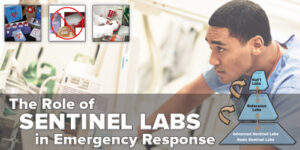
The Role of Sentinel Labs in Emergency Response
There are five sections in this course: Section 1: The National Laboratory Response Network Section 2: Basic and Advanced Sentinel Laboratories Section 3: Role of Public Health Labs in Emergency Response Section 4: Role of Sentinel Laboratories in a Bioterrorism Event Section 5: Role of Sentinel Laboratories in a Chemical Event Modules 1 through 3 contain "pop quizzes" to assist you in understanding and assimilating the information. Module 4 and 5 contains scenario exercises to enable you to apply what you have learned to situations that may occur during a bioterrorism or chemical event. Intended Audience — Individuals who work...